
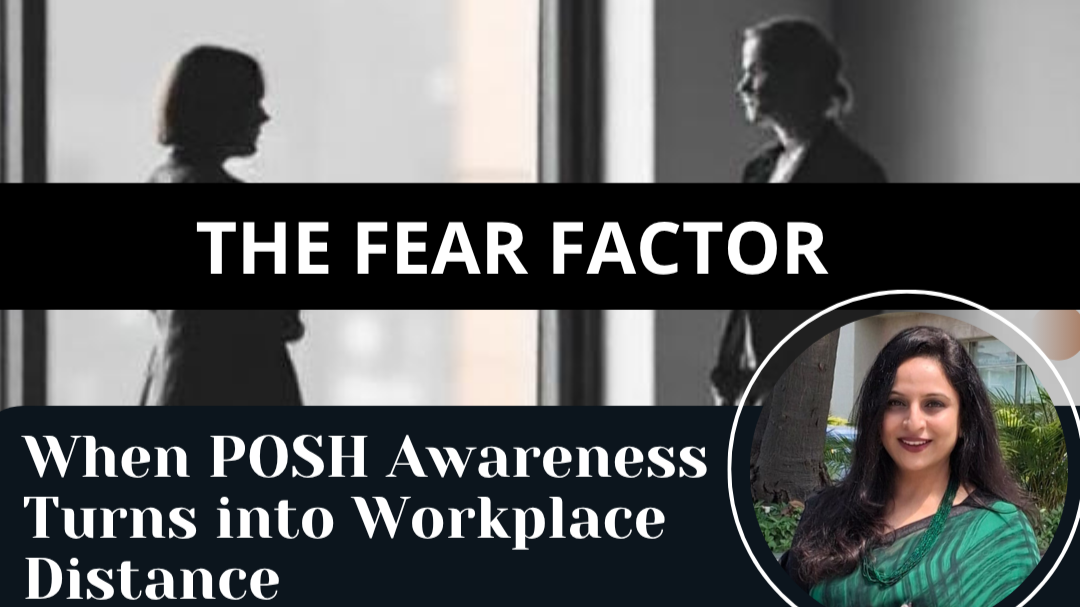
A real-life moment that made me pause
During one of my POSH TTT program, the Presiding Officer of the Internal Committee raised a question that caught the entire room’s attention:
“Ma’am, we’ve made everyone aware about POSH. People understand what not to do. But now, many male employees avoid meeting a female colleague alone in a cabin. They fear being misunderstood or falsely accused. What can we do about this?”
The room fell silent. It wasn’t a question from ignorance — it came from awareness and anxiety.
This, to me, is one of the most intriguing cultural shifts happening inside workplaces today. As awareness about the POSH Act grows — something we’ve all worked tirelessly to achieve — it’s bringing along a shadow emotion: FEAR
The unintended ripple effect of awareness
When the POSH Act was implemented in 2013, the intent was clear — to make workplaces safer, inclusive, and free of harassment. Over the years, we’ve made incredible progress. Employees now know their rights, organizations have formed Internal Committees, and conversations about dignity at work have become mainstream.
But with every movement towards safety, there also arises a cautious overcorrection.
Male colleagues, especially in senior roles, often hesitate to:
- Mentor or meet female employees one-on-one.
- Include women in informal team gatherings.
- Have open conversations that once built camaraderie.
The intent behind this hesitation? Fear of being misinterpreted, recorded, or falsely complained against.
Why does this fear exist?
- Lack of understanding of what “harassment” truly means Many believe that any disagreement or emotional discomfort could be construed as harassment. In reality, the law clearly distinguishes between intentional, repeated, and unwelcome conduct and professional interactions.
- Media amplification of ‘fake complaint’ narratives A handful of high-profile cases where complaints were proven false often get magnified, overshadowing the thousands of genuine ones.
- Absence of safe dialogue spaces While organizations conduct POSH training, few hold open forums for men and women to express their apprehensions honestly. Awareness without conversation breeds fear, not confidence.
- Power imbalance and perception anxiety Senior men worry that any interaction with a junior female colleague could be seen through a “positional power” lens, even when intentions are clean.
The grey area — the invisible wall
Let’s admit it: the law was never meant to separate genders. Yet, in some workplaces, it’s unintentionally doing just that.
- Women lose access to mentorship and networking opportunities because their male seniors prefer to “stay safe.”
- Men feel under scrutiny, avoiding even normal gestures of politeness.
- Workplaces start operating under subtle tension, with gender becoming a filter for every interaction.
The result? Safety achieved at the cost of trust.
So, what’s the right balance?
The answer lies not in reducing awareness, but in deepening understanding.
Here’s how organizations can bridge this trust gap:
- Train both genders, not just one Awareness sessions should address fears of misuse openly. Let men ask difficult questions. Let women hear those fears. When both perspectives are heard, empathy grows.
- Encourage transparent workplace practices Keep meeting rooms with glass doors. Use formal communication channels (email, official chats) for work discussions. Promote two-person mentoring models — not as a sign of suspicion, but as a culture of openness.
- Reinforce that POSH is about conduct, not control POSH doesn’t restrict communication; it defines boundaries of respect. Genuine, professional interactions have nothing to fear.
- Address false complaint anxiety factually Data shows that less than 3% of POSH complaints are proven malicious or false (source: MWCD, 2023). The fear is far larger than the reality.
- Leadership messaging matters When leaders say, “We stand for fairness — both for complainants and respondents,” it reassures everyone that the system protects truth, not gender.
The mindset shift we need
Instead of saying “Don’t meet female colleagues alone”, we should be saying — “Meet anyone, but conduct yourself with respect, professionalism, and accountability.” True gender respect doesn’t come from distance — it comes from discipline and dignity.
Let’s move from fear to fairness
The POSH Act was born out of courage — courage of survivors who spoke up. Now, as awareness matures, we must ensure it doesn’t replace courage with caution.
If men and women start working with fear instead of trust, we’ll lose the very spirit of equality we’re striving to protect.
The goal isn’t to create a workplace where no one talks — it’s to create one where everyone talks with respect.